
Britain’s £28 billion grid upgrade marks the shift from physical reinforcement to intelligence-led national energy operations. QGEMS explains how system resilience now depends on real time coordination across transmission, distribution, and millions of distributed assets. It details how QGEMS activates whole-system awareness through ERPMO and GemAI, unifying operational behaviour, financial integrity, and compliance inside a single digital architecture.
It also examines the implications for social housing portfolios and public estates, where rising electrification, heat-pump deployment, and estate-scale upgrades intensify operational pressure on the grid. Real time intelligence becomes essential for reducing tenant energy costs, improving EPC performance, confirming regulatory compliance, and orchestrating complex multi-building energy environments across local authorities, NHS estates, defence sites, and large regeneration schemes.
Ofgem’s £28 Billion Grid Upgrade Signals The Arrival Of Britain’s Intelligent Energy Era
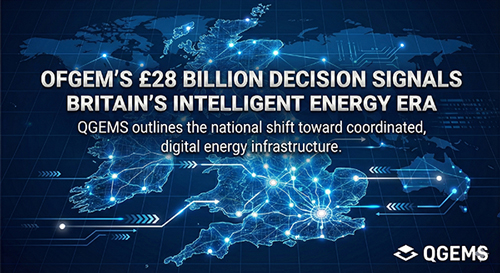
Britain has entered a decisive phase of national energy transformation. Ofgem’s approval of £28 billion in grid investment confirms that the country will modernise its infrastructure at unprecedented scale. This commitment recognises that physical reinforcement alone cannot meet the demands of electrification, distributed generation, and AI-driven load growth. National resilience now depends on real-time intelligence that unifies operations, finance, and compliance in real-time.
QGEMS strengthens this foundation by providing the Digital Energy Ecosystem that connects the grid edge to the grid core. It activates whole-system awareness, orchestrates distributed assets with precision, and creates verifiable financial transparency for operators, investors, and policymakers. The result is a national energy environment where constraints are anticipated, flexibility becomes dispatchable, and every asset contributes measurable value to the system.
Britain’s social housing providers face rising pressure to lift EPC ratings, reduce tenant energy costs, and deploy heat pumps and battery systems at portfolio scale. Public estates across health, defence, and education experience similar operational pressures. Ofgem’s investment strengthens the national infrastructure required to support these upgrades and allows digital intelligence to guide compliant, cost-efficient delivery.
Great British Energy’s multi-year plan aligns with this shift. The United Kingdom is expanding renewable capacity and accelerating electrification across heat, transport, and industry. Success requires intelligence equal to the scale of the physical network. QGEMS delivers that capability through ERPMO and GemAI, enabling Britain to convert capital expenditure into operational resilience and sovereign digital control.
Gordon Winston, QGEMS CEO and Founder, reinforces this position:
“Britain’s investment signals a national priority. Real-time intelligence now defines energy security and system reliability. QGEMS provides the architecture that transforms distributed assets into coordinated energy and financial participants. The country is modernising its grid. We ensure it operates as a unified, verifiable, and resilient system.”
This transformation reaches beyond utilities. It shapes how social landlords design retrofit programmes, how local authorities plan public-estate upgrades, and how major developers structure regeneration schemes. QGEMS provides the real-time intelligence that aligns these decisions with national grid behaviour and financial reality.
As the nation prepares for the most significant grid upgrade in a generation, QGEMS stands at the centre of this transformation. It provides the real-time intelligence required to turn £28 billion of physical reinforcement into a stable, efficient, and globally leading energy system.