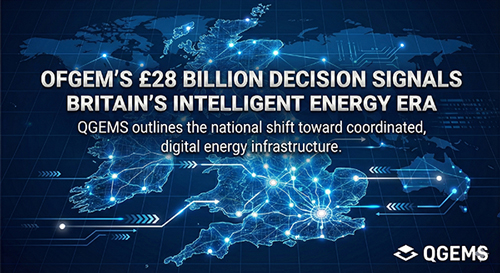
Ofgem’s £28 Billion Grid Upgrade Signals The Arrival Of Britain’s Intelligent Energy Era

Ofgem’s £28 Billion Grid Upgrade Signals The Arrival Of Britain’s Intelligent Energy Era

Britain’s £28 billion grid upgrade marks the shift from physical reinforcement to intelligence-led national energy operations. QGEMS explains how system resilience now depends on real time coordination across transmission, distribution, and millions of distributed assets. It details how QGEMS activates whole-system awareness through ERPMO and GemAI, unifying operational behaviour, financial integrity, and compliance inside a single digital architecture.

It also examines the implications for social housing portfolios and public estates, where rising electrification, heat-pump deployment, and estate-scale upgrades intensify operational pressure on the grid. Real time intelligence becomes essential for reducing tenant energy costs, improving EPC performance, confirming regulatory compliance, and orchestrating complex multi-building energy environments across local authorities, NHS estates, defence sites, and large regeneration schemes.

Month: December 2025

Dec 8, 2025

Britain has entered a decisive phase of national energy transformation. Ofgem’s approval of £28 billion in grid investment confirms that the country will modernise its infrastructure at unprecedented scale. This commitment recognises that physical reinforcement alone cannot meet the demands of electrification, distributed generation, and AI-driven load growth. National resilience now depends on real-time intelligence that unifies operations, finance, and compliance in real-time.

QGEMS strengthens this foundation by providing the Digital Energy Ecosystem that connects the grid edge to the grid core. It activates whole-system awareness, orchestrates distributed assets with precision, and creates verifiable financial transparency for operators, investors, and policymakers. The result is a national energy environment where constraints are anticipated, flexibility becomes dispatchable, and every asset contributes measurable value to the system.

Britain’s social housing providers face rising pressure to lift EPC ratings, reduce tenant energy costs, and deploy heat pumps and battery systems at portfolio scale. Public estates across health, defence, and education experience similar operational pressures. Ofgem’s investment strengthens the national infrastructure required to support these upgrades and allows digital intelligence to guide compliant, cost-efficient delivery.

Great British Energy’s multi-year plan aligns with this shift. The United Kingdom is expanding renewable capacity and accelerating electrification across heat, transport, and industry. Success requires intelligence equal to the scale of the physical network. QGEMS delivers that capability through ERPMO and GemAI, enabling Britain to convert capital expenditure into operational resilience and sovereign digital control.

Gordon Winston, QGEMS CEO and Founder, reinforces this position:

“Britain’s investment signals a national priority. Real-time intelligence now defines energy security and system reliability. QGEMS provides the architecture that transforms distributed assets into coordinated energy and financial participants. The country is modernising its grid. We ensure it operates as a unified, verifiable, and resilient system.”

This transformation reaches beyond utilities. It shapes how social landlords design retrofit programmes, how local authorities plan public-estate upgrades, and how major developers structure regeneration schemes. QGEMS provides the real-time  intelligence that aligns these decisions with national grid behaviour and financial reality.

As the nation prepares for the most significant grid upgrade in a generation, QGEMS stands at the centre of this transformation. It provides the real-time intelligence required to turn £28 billion of physical reinforcement into a stable, efficient, and globally leading energy system.
Why AWS Framing Misses the Real Transformation Underway

Why AWS Framing Misses the Real Transformation Underway

Why AWS’s Framing Misses The Real Transformation Underway

By Gordon Wilson

GemAI is QGEMS’ industrial-grade AI and machine-learning platform built specifically for electrification, microgrid optimisation, and distributed energy management. Unlike generic cloud-AI toolchains, GemAI combines physics-based engineering models with data-driven energy forecasting, enabling closed-loop optimisation across solar, batteries, heat pumps, EV chargers, and flexible loads. It is deployed inside public-sector estates, campuses, and commercial portfolios where reliability, cost reduction, and carbon reduction are mandatory, not experimental.

1. Energy AI is not about dashboards becoming agents

AWS frames progress as a transition from dashboards to automated agent actions. That is outdated. The real shift is from static, asset-level control to dynamic, systemwide optimisation across millions of distributed points of consumption, generation, and storage. The next frontier is not automating single-loop decisions inside a utility’s existing process, it is orchestrating the entire energy ecosystem in real time, from the grid edge and to the core.

This is precisely the gap that GemAI was built to address.

2. The idea that only utilities’ internal PhD electrical engineers can deliver successful AI projects is wrong

AWS claims that only engineers deeply embedded inside utilities can define viable AI experiments. This does not reflect how modern energy optimisation works.

The most successful deployments today are being driven by companies that combine deep domain expertise with real-world operating data across thousands of sites, not isolated utility engineering teams.

GemAI is engineered around this principle. It merges:

  • QGEMS’ sector-specific engineering models,
  • real-time metering and behavioural data,
  • energy forecasting models trained on building stock and electrification scenarios, and
  • control logic optimised for microgrids, DER integration, flexible demand, and real-time energy orchestration.

This hybrid approach consistently outperforms internal utility AI pilots because it is built on an actual market reality: electrification is happening inside homes, businesses, and campuses, not inside a utility control room.

3. AWS overstates the maturity of closed-loop operational AI

The claim that most energy systems are deterministic and therefore suited for AI-driven autonomous action ignores the fact that grid-edge conditions are highly stochastic: behaviour, weather, load volatility, and DER availability cannot be assumed stable.

GemAI solves this using models specifically built for:

  • non-stationary load environments,
  • probabilistic outcomes,
  • cascading failure detection,
  • rapid re-optimisation in low-data or missing-data states, and
  • energy-behaviour prediction tuned for decarbonising building portfolios.

Our technology does not assume order in a chaotic system, rather it learns in chaos and performs in it.

4. Rapid experimentation is not a virtue if the experiments are meaningless

AWS promotes “100 cheap experiments to find 5 that work.” In energy infrastructure this is irresponsible. Public-sector estates, critical campuses, and commercial portfolios cannot tolerate failed experiments that disrupt operations or inflate costs.

GemAI is built on validated engineering models and field performance. It reduces risk, not multiplies it. The platform is trained on live operational data from microgrids, heat pumps, EV chargers, solar, and hybrid systems all drawn from real deployments. Customers see ROI because the models start from real constraints, instead of toy prototypes and Silicon Valley experimentation culture.

5. DERMS and grid-scale optimisation are only half the picture

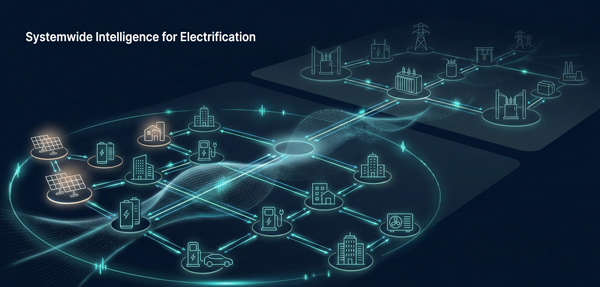
The energy system of the next decade requires intelligence at both ends:

  • Utility-side optimisation (traditional DERMS)
  • Customer-side optimisation (electrification, microgrids, estates management)

GemAI is one of the only industrial AI energy platforms that spans both: modelling, forecasting, and optimising the entire electrification stack from the building level up to campus-scale microgrids, while providing the commercial logic needed to support MaaS business models.

AWS highlights GE Vernova, Hitachi, and Siemens. These are grid-centric solutions. QGEMS targets the largest growth opportunity: the distributed, flexible, behind-the-meter estate that actually determines whether markets decarbonise at speed.

6. Efficiency claims for hyperscale AI ignore the real energy problem

AWS emphasises reductions in data-centre chip power consumption. That is irrelevant to the actual challenge: data-centre load growth is so extreme that even a 60% efficiency gain cannot offset the exponential rise in demand.

GemAI approaches the problem differently. It helps organisations permanently lower their grid draw, flatten their demand curves, and optimise storage, tariffs, and flexibility markets. Reducing consumption is more impactful than optimising the consumption of servers that are irrelevant for most energy applications.