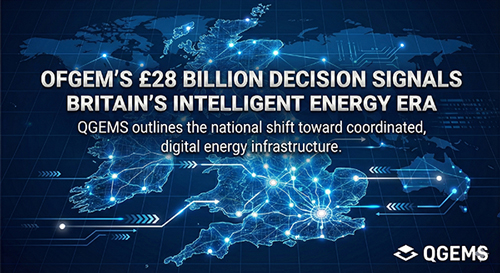
Ofgem’s £28 Billion Grid Upgrade Signals The Arrival Of Britain’s Intelligent Energy Era

Ofgem’s £28 Billion Grid Upgrade Signals The Arrival Of Britain’s Intelligent Energy Era

Britain’s £28 billion grid upgrade marks the shift from physical reinforcement to intelligence-led national energy operations. QGEMS explains how system resilience now depends on real time coordination across transmission, distribution, and millions of distributed assets. It details how QGEMS activates whole-system awareness through ERPMO and GemAI, unifying operational behaviour, financial integrity, and compliance inside a single digital architecture.

It also examines the implications for social housing portfolios and public estates, where rising electrification, heat-pump deployment, and estate-scale upgrades intensify operational pressure on the grid. Real time intelligence becomes essential for reducing tenant energy costs, improving EPC performance, confirming regulatory compliance, and orchestrating complex multi-building energy environments across local authorities, NHS estates, defence sites, and large regeneration schemes.

Energy Gems

Dec 8, 2025

Britain has entered a decisive phase of national energy transformation. Ofgem’s approval of £28 billion in grid investment confirms that the country will modernise its infrastructure at unprecedented scale. This commitment recognises that physical reinforcement alone cannot meet the demands of electrification, distributed generation, and AI-driven load growth. National resilience now depends on real-time intelligence that unifies operations, finance, and compliance in real-time.

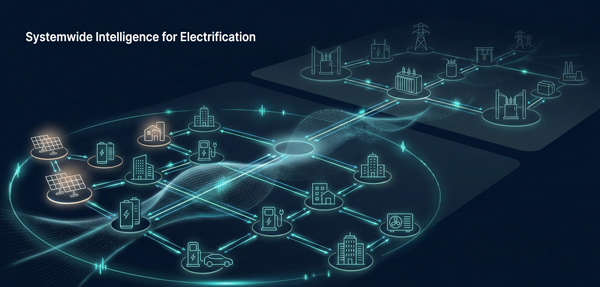
QGEMS strengthens this foundation by providing the Digital Energy Ecosystem that connects the grid edge to the grid core. It activates whole-system awareness, orchestrates distributed assets with precision, and creates verifiable financial transparency for operators, investors, and policymakers. The result is a national energy environment where constraints are anticipated, flexibility becomes dispatchable, and every asset contributes measurable value to the system.

Britain’s social housing providers face rising pressure to lift EPC ratings, reduce tenant energy costs, and deploy heat pumps and battery systems at portfolio scale. Public estates across health, defence, and education experience similar operational pressures. Ofgem’s investment strengthens the national infrastructure required to support these upgrades and allows digital intelligence to guide compliant, cost-efficient delivery.

Great British Energy’s multi-year plan aligns with this shift. The United Kingdom is expanding renewable capacity and accelerating electrification across heat, transport, and industry. Success requires intelligence equal to the scale of the physical network. QGEMS delivers that capability through ERPMO and GemAI, enabling Britain to convert capital expenditure into operational resilience and sovereign digital control.

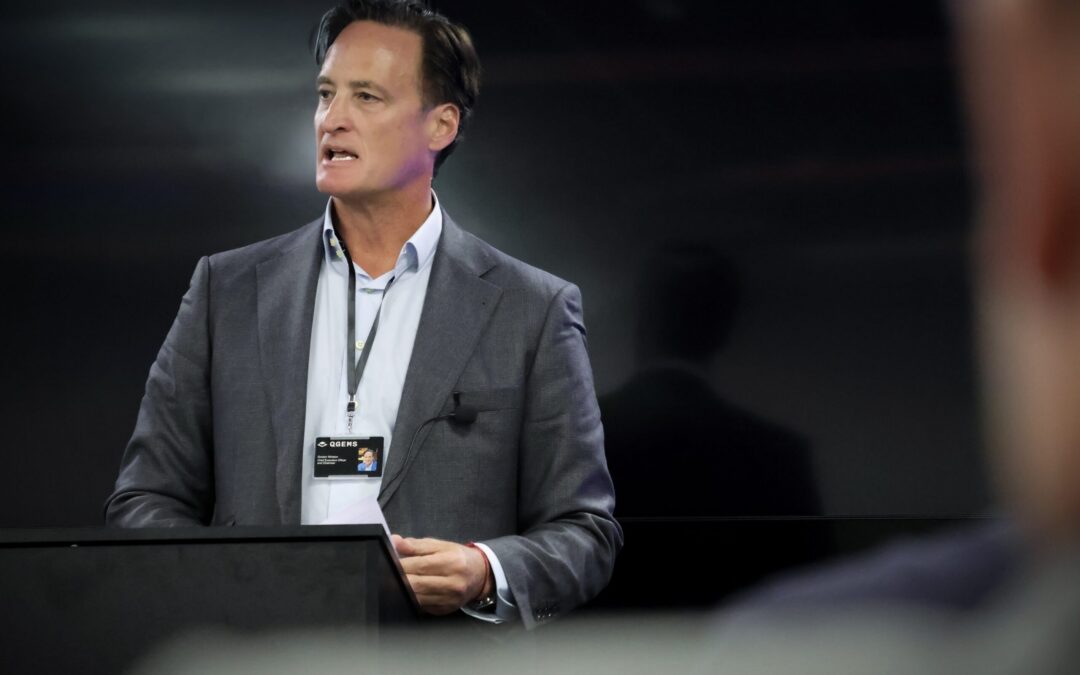
Gordon Winston, QGEMS CEO and Founder, reinforces this position:

“Britain’s investment signals a national priority. Real-time intelligence now defines energy security and system reliability. QGEMS provides the architecture that transforms distributed assets into coordinated energy and financial participants. The country is modernising its grid. We ensure it operates as a unified, verifiable, and resilient system.”

This transformation reaches beyond utilities. It shapes how social landlords design retrofit programmes, how local authorities plan public-estate upgrades, and how major developers structure regeneration schemes. QGEMS provides the real-time  intelligence that aligns these decisions with national grid behaviour and financial reality.

As the nation prepares for the most significant grid upgrade in a generation, QGEMS stands at the centre of this transformation. It provides the real-time intelligence required to turn £28 billion of physical reinforcement into a stable, efficient, and globally leading energy system.
Why AWS Framing Misses the Real Transformation Underway

Why AWS Framing Misses the Real Transformation Underway

Why AWS’s Framing Misses The Real Transformation Underway

By Gordon Wilson

GemAI is QGEMS’ industrial-grade AI and machine-learning platform built specifically for electrification, microgrid optimisation, and distributed energy management. Unlike generic cloud-AI toolchains, GemAI combines physics-based engineering models with data-driven energy forecasting, enabling closed-loop optimisation across solar, batteries, heat pumps, EV chargers, and flexible loads. It is deployed inside public-sector estates, campuses, and commercial portfolios where reliability, cost reduction, and carbon reduction are mandatory, not experimental.

1. Energy AI is not about dashboards becoming agents

AWS frames progress as a transition from dashboards to automated agent actions. That is outdated. The real shift is from static, asset-level control to dynamic, systemwide optimisation across millions of distributed points of consumption, generation, and storage. The next frontier is not automating single-loop decisions inside a utility’s existing process, it is orchestrating the entire energy ecosystem in real time, from the grid edge and to the core.

This is precisely the gap that GemAI was built to address.

2. The idea that only utilities’ internal PhD electrical engineers can deliver successful AI projects is wrong

AWS claims that only engineers deeply embedded inside utilities can define viable AI experiments. This does not reflect how modern energy optimisation works.

The most successful deployments today are being driven by companies that combine deep domain expertise with real-world operating data across thousands of sites, not isolated utility engineering teams.

GemAI is engineered around this principle. It merges:

  • QGEMS’ sector-specific engineering models,
  • real-time metering and behavioural data,
  • energy forecasting models trained on building stock and electrification scenarios, and
  • control logic optimised for microgrids, DER integration, flexible demand, and real-time energy orchestration.

This hybrid approach consistently outperforms internal utility AI pilots because it is built on an actual market reality: electrification is happening inside homes, businesses, and campuses, not inside a utility control room.

3. AWS overstates the maturity of closed-loop operational AI

The claim that most energy systems are deterministic and therefore suited for AI-driven autonomous action ignores the fact that grid-edge conditions are highly stochastic: behaviour, weather, load volatility, and DER availability cannot be assumed stable.

GemAI solves this using models specifically built for:

  • non-stationary load environments,
  • probabilistic outcomes,
  • cascading failure detection,
  • rapid re-optimisation in low-data or missing-data states, and
  • energy-behaviour prediction tuned for decarbonising building portfolios.

Our technology does not assume order in a chaotic system, rather it learns in chaos and performs in it.

4. Rapid experimentation is not a virtue if the experiments are meaningless

AWS promotes “100 cheap experiments to find 5 that work.” In energy infrastructure this is irresponsible. Public-sector estates, critical campuses, and commercial portfolios cannot tolerate failed experiments that disrupt operations or inflate costs.

GemAI is built on validated engineering models and field performance. It reduces risk, not multiplies it. The platform is trained on live operational data from microgrids, heat pumps, EV chargers, solar, and hybrid systems all drawn from real deployments. Customers see ROI because the models start from real constraints, instead of toy prototypes and Silicon Valley experimentation culture.

5. DERMS and grid-scale optimisation are only half the picture

The energy system of the next decade requires intelligence at both ends:

  • Utility-side optimisation (traditional DERMS)
  • Customer-side optimisation (electrification, microgrids, estates management)

GemAI is one of the only industrial AI energy platforms that spans both: modelling, forecasting, and optimising the entire electrification stack from the building level up to campus-scale microgrids, while providing the commercial logic needed to support MaaS business models.

AWS highlights GE Vernova, Hitachi, and Siemens. These are grid-centric solutions. QGEMS targets the largest growth opportunity: the distributed, flexible, behind-the-meter estate that actually determines whether markets decarbonise at speed.

6. Efficiency claims for hyperscale AI ignore the real energy problem

AWS emphasises reductions in data-centre chip power consumption. That is irrelevant to the actual challenge: data-centre load growth is so extreme that even a 60% efficiency gain cannot offset the exponential rise in demand.

GemAI approaches the problem differently. It helps organisations permanently lower their grid draw, flatten their demand curves, and optimise storage, tariffs, and flexibility markets. Reducing consumption is more impactful than optimising the consumption of servers that are irrelevant for most energy applications.

QGEMS Launches AI Energy Cluster to Transform the UK’s Energy Intelligence Landscape

QGEMS Launches AI Energy Cluster to Transform the UK’s Energy Intelligence Landscape

For Immediate Release: 
Newcastle, U.K., 14 October 2025 - QGEMS has launched the AI Energy Cluster, a next-generation platform redefining how energy systems are managed, optimised, and validated. Developed at its Newcastle R&D headquarters, the Cluster unites utilities, universities, investors, financial institutions, and innovators into a shared Energy Intelligence Fabric that forecasts, optimises, orchestrates, and monetises energy across the grid edge.

Powered by the GemAI platform, trained on millions of data points and tested to trillions in collaboration with Google, QGEMS turns complex distributed energy data into actionable insight, enabling real-time predictive control and reporting transparency across the entire energy landscape.

“The AI Energy Cluster transforms innovation into a live, data-driven ecosystem that learns, adapts, and scales,” said Gordon Winston, QGEMS CEO. “Our goal is to make every kilowatt smarter and every investment accountable.”

AI Clusters as Supernodes

At the core of QGEMS’ architecture are AI Clusters as Supernodes, digitally validated energy ecosystems that unify technical, financial, and environmental intelligence. Each Supernode acts as both a data hub and value node, combining orchestration with financial verification to quantify the commercial, environmental, and systemic value of energy assets.

For investors, banks, and institutions, Supernodes create market-validated digital assets whose financial performance is transparently tied to operational and carbon outcomes. They enable:

  • Investor-grade assurance through live, verified performance data
  • Dynamic credit models built on continuous digital validation
  • Market-integrated decisioning linking AI insight to flexibility and grid services
  • Replicable archetypes that accelerate project deployment

This introduces digitally verifiable transition finance, where intelligence becomes an investable asset.

Driving Net Zero Innovation at Scale

The AI Energy Cluster accelerates the UK’s Net Zero mission through auditable data, automated compliance, and predictive market insight. Aligned with the Transition Finance Council, chaired by Rt. Hon. Chris Skidmore, QGEMS Advisory Director, it connects digital intelligence to tangible investment outcomes, demonstrating how coordination multiplies the value of every pound invested in clean infrastructure.

The QGEMS ‘Hypergrid’ integrates the grid, distributed energy, and intelligence to flow bidirectionally, allowing citizens, communities, local authorities and investors to share in the stability and value they help create. The AI Energy Cluster expands this vision while strengthening the North East’s technology base.

About QGEMS

QGEMS pioneers’ intelligent energy systems through AI-enabled orchestration, validation, and simulation. Its Energy Resource Planning, Management, and Optimization (ERPMO) platform integrates and aggregates distributed energy assets, intelligently orchestrated with the grid to create a Hypergrid enhancing resilience, flexibility, and cost efficiency. Partnering with system operators, local authorities, research institutions, and financial institutions, QGEMS is building a decarbonised, decentralised, and democratised energy future.

QGEMS Digital Energy Ecosystem connects consumers (including C&I), investors, and grid operators in a unified framework. This ecosystem ensures that every participant, from households and communities to institutional investors and system operators, benefits from verifiable data, optimised performance, and transparent value creation across the entire energy chain.

QGEMS Energy Ltd., headquartered in Newcastle, operates nationally across the UK with international expansion well under way.

Media Enquiries

QGEMS

Email: gcohen@qgems.energy

Phone: +441917431122 Ext. 1006

Website: www.qgems.energy

QGEMS and Former UK Energy Minister launch One Million Homes initiative to save a million homes’ worth of electricity through AI software

QGEMS and Former UK Energy Minister launch One Million Homes initiative to save a million homes’ worth of electricity through AI software

For Immediate Release: 
Newcastle, U.K., 14 October 2025 - The former U.K. Energy Minister and Chair of the U.K.’s Net Zero Review Chris Skidmore has launched a new campaign to save the equivalent of one million homes worth of electricity- to demonstrate how net zero isn’t a cost but can reduce people’s energy bills through better use of ‘smart energy’ software that uses latest AI technology to monitor and optimise electricity use - reducing bills by up to 40%.

The campaign was launched alongside QGEMS, a distributed energy management software provider, who create "virtual power plants" that can network properties to optimise their use of energy at the best time, at their offices in Newcastle. The campaign will seek to establish also a new hub in the North East to bring property owners together across residential, commercial and public buildings to deliver electricity savings.

The One Million Homes initiative will now host regional events and round tables across the country to bring potential partners together to make the one million homes saving. This is the equivalent of 1 GW hour of electricity or the equivalent of Hornsea 1 wind farm. The campaign will also be engaging and working alongside key property landowners and organisations focused on the built environment.

In his Newcastle launch speech (full copy attached) Chris Skidmore highlighted how existing buildings can be used to reduce energy costs and ultimately customer’s bills.

Chris Skidmore said:

“We need for energy demand that same sense of mission that we now have for clean power by 2030. In the Net Zero Review, Mission Zero Report, I set out ten missions that could be focused upon to help deliver the government’s commitments. Yet with the new technology and growth in capability we now have through the generation of AI and optimisation software, we should be adding an extra mission to these, one that can sit alongside the clean power mission for 2030, that can make a real difference, a real discernable change before 2030- proving the case that the energy transition is making lives better and saving money.

I want to help shape a new mission that we can all deliver, one that can clearly highlight the continued potential of flexibility and optimisation to ensure that we can find energy savings within our existing systems, whether those are across residential, commercial, industrial properties, or across council and government owned public buildings. All have the potential to be not just users of energy, but owners of energy. Making the most of the assets that we already have, the buildings that we live and work in, to turn these into revenue generators, traders of electricity, not merely purchasers. The greatest empowerment opportunity of our generation.

We need a mission for the energy transition that is going to give back to people: to show them how they can directly benefit. Highlighting how technology can reduce their costs, demonstrating how savings can be made, will be vital to that vision.

Today, I want to announce that together with QGEMS, we are launching a new initiative, ‘One Million Homes’, to identify and ultimately realise across the built environment sectors mentioned, how we can find and deliver one million homes worth of electricity in savings and optimisation before 2030, the equivalent of 1 gigawatt hour of electricity or Hornsea 1 wind farm.

The journey to reach the One Million Homes mission starts today. It is a mission that I hope we can gather further backing: the technology is ready to go, the savings are ready to be made. All that is needed is willing and supportive partners to get onboard.

As part of the mission, I will be hosting roundtables across the country to build the coalition across other organisations and partners willing to get involved. We are keen to work with those willing to join the mission, to strike up partnerships and pilots with QGEMS, to see what might be possible, and to start delivering the benefits that optimisation and AI can bring at scale to their organisations or properties.”

Gordon Winston said:

“QGEMS views finance, inventive capital, energy, and technology as a single, connected ecosystem with the trust, capability, and scale that can power the UK transition to net zero. In creating the Internet of Energy, QGEMS combines the traditional and digital grids with the open energy markets to deliver the digital energy ecosystem and direct capital to what matters. Chris Skidmore’s transition finance and net-zero frameworks set the global benchmark for a sustainable future. I am proud to stand alongside Chris, policymakers, investors, and innovators to turn these ambitions into delivery. ”


About Chris Skidmore

Chris Skidmore was the UK's Cabinet Minister for Energy who signed the UK's net zero commitment into law in 2019- becoming the first G7 country to do so. He was also Chair of the Net Zero Review and published the influential Mission Zero rekey in 2023. He is now Chair of the Policy Group of the U.K. Transition Finance Council.


About QGEMS

QGEMS pioneers’ intelligent energy systems through AI-enabled orchestration, validation, and simulation. Its Energy Resource Planning, Management, and Optimization (ERPMO) platform integrates and aggregates distributed energy assets, intelligently orchestrated with the grid to create a Hypergrid enhancing resilience, flexibility, and cost efficiency. Partnering with system operators, local authorities, research institutions, and financial institutions, QGEMS is building a decarbonised, decentralised, and democratised energy future.

QGEMS Digital Energy Ecosystem connects consumers (including C&I), investors, and grid operators in a unified framework. This ecosystem ensures that every participant, from households and communities to institutional investors and system operators, benefits from verifiable data, optimised performance, and transparent value creation across the entire energy chain.

QGEMS Energy Ltd., headquartered in Newcastle, operates nationally across the UK with international expansion well under way.

Media Enquiries:

QGEMS
Email: gcohen@qgems.energy
Phone: +44 (0)191 743 1122 Ext. 1006
Website: www.qgems.energy


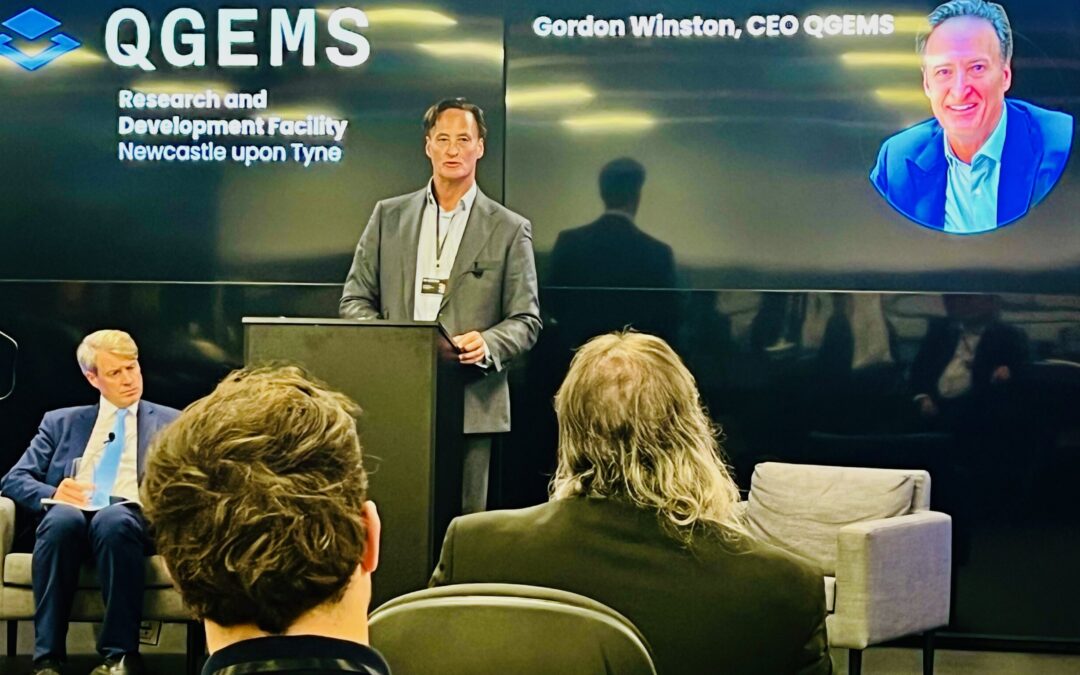
Rt Hon Chris Skidmore and QGEMS CEO Gordon Winston during the launch of the 1 million homes initiative

Rt Hon Chris Skidmore and QGEMS CEO Gordon Winston at QGEMS Research and Development Facility in Newcastle upon Tyne during the launch of the One Million Homes initiative to save the energy of 1 million homes through AI software by 2030.

Rt. Hon. Chris Skidmore speaking at QGEMS in Newcastle at the launch of the One Million Homes initiative to save the energy of 1 million homes  through AI software by 2030.

Rt. Hon. Chris Skidmore speaking at QGEMS in Newcastle at the launch of the One Million Homes initiative to save the energy of 1 million homes through AI software by 2030.

Behind-the-Meter Flexibility: Utilities’ Best Response to Energy Investment Uncertainty

Behind-the-Meter Flexibility: Utilities’ Best Response to Energy Investment Uncertainty

Utility Resilience Starts Behind the Meter

As utilities face growing uncertainty from inflation, geopolitical tensions, climate volatility, and accelerating electrification, one solution rises above the noise: behind-the-meter flexibility. According to a recent UtilityDive opinion article, it's one of the smartest, low-risk, high-reward strategies in today's volatile energy landscape.QGEMS is proud to be named in the article as a leading "grid to grid-edge energy orchestration platform."

QGEMS UtilityDive Opinion piece QGEMS & Utilities


By using AI to manage energy flow across the full energy spectrum, from centralized generation to distributed customer-sited DERs, QGEMS offers utilities a smarter path forward.


Why Utilities Are Turning to Behind-the-Meter Flexibility

Resilience Across All Grid Levels

QGEMS allows utilities to dynamically orchestrate DERs and microgrids, mitigating outages, and improving real-time resilience during extreme weather and other disruptions.

Deferred Infrastructure Spending

Rather than investing in costly new transmission and generation, utilities can utilize QGEMS Distributed Energy Operating System (DE-OS) to unlock flexible capacity from grid-edge resources already in place and to defer or even eliminate some large capital expenditures.

Reduced Market Risk

By leveraging assets like solar plus battery storage, EV chargers, and intelligent thermostats through virtual power plants (VPPs) and the more expansive QGEMS’ VNPP (Virtual Network Power Plant), utilities reduce exposure to fuel price volatility and global supply disruptions

Future-Proof Grid Modernization

QGEMS’ VNPP (Virtual Network Power Plant) framework helps utilities build digital, decentralized, and demand-responsive infrastructure which is a foundational step in transitioning to a truly modern grid

Why Utilities Are Turning to Behind-the-Meter Flexibility

Grid to grid-edge energy orchestration platforms, such as QGEMS, leverage AI to optimize energy use at all levels between grid edge and grid... In the case of extreme weather or other disruptions, multi-level control and microgrid islanding capabilities allow the utility to better manage and avoid power outages, improving grid resilience.

Invest Smarter with QGEMS

In a landscape where traditional grid investments carry growing risk, QGEMS offers a smarter, scalable path to deliver clean, affordable, and resilient energy.

Grid to grid-edge energy orchestration platforms, such as QGEMS, leverage AI to optimize energy use at all levels between grid edge and grid... In the case of extreme weather or other disruptions, multi-level control and microgrid islanding capabilities allow the utility to better manage and avoid power outages, improving grid resilience.

Check out the full UtilityDIve Opinion article "Behind-the-meter flexibility is the best response to investment uncertainty" to see how the industry is evolving and how QGEMS is leading that transformation.

The highlights of the post are as follows:

At the same time that Utilities are navigating rising uncertainty from inflation, geopolitical shifts, supply chain disruptions, and exploding energy demand, behind-the-meter flexibility is emerging as a low-risk, high-reward strategy. By aggregating and orchestrating distributed energy resources (DERs) into Virtual Power Plants (VPPs), or more expansively into what QGEMS defines as Virtual Network Power Plants (VNPPs), utilities can unlock flexible, customer-sited grid-edge capacity that strengthens grid resilience, reduces reliance on volatile fuel markets, and defers costly infrastructure investments.

Solutions like QGEMS enable real-time optimization from the grid-edge to grid-core, enhancing reliability during extreme weather and enabling smarter, more efficient energy management. In a landscape of unpredictable variables, behind-the-meter flexibility is a future-proof, no-regret investment for clean, reliable, and resilient energy delivery.

In UtilityDive's Opinion piece, they say, utilities must also prioritize investments that address grid resilience at multiple levels. Grid to grid-edge energy orchestration platforms, such as QGEMS, leverage AI to optimize energy use at all levels between grid edge and core, maximizing investments in behind-the-meter flexibility. Utilities using this platform can target investments in DERs to alleviate constraints and improve energy quality, reliability and resilience on specific portions of the grid. In the case of extreme weather or other disruptions, multi-level control and microgrid islanding capabilities allow the utility to better manage and avoid power outages, improving grid resilience.

Read the full UtilityDIve Opinion → "Behind-the-meter flexibility is the best response to investment uncertainty"

NAAREA Partners with QGEMS to Revolutionize Energy Management Across Multiple Sectors

NAAREA Partners with QGEMS to Revolutionize Energy Management Across Multiple Sectors

The partnership marks a significant step in NAAREA's mission to revolutionize the clean energy landscape. By leveraging QGEMS' cutting-edge platform, NAAREA will enhance the efficiency and reliability of its energy operations, ensuring seamless integration into the broader energy grid and various sectors. 

"As we prepare to bring our energy production online, partnering with QGEMS was a natural choice," said Jean-Luc Alexandre, CEO of NAAREA. "Their expertise in energy management aligns perfectly with our goal of delivering clean, reliable energy solutions across multiple industries. This collaboration will allow us to optimize our energy production and distribution, maximizing the impact of our technology." 

Key benefits of the NAAREA-QGEMS partnership include: 

The partnership will address critical energy management needs across various sectors: 

  • High fidelity tracking and attribution of energy including sources, renewables, and sovereignty
  • Enhanced grid integration capabilities
  • Improved demand forecasting and supply management
  • Advanced analytics for operational efficiency
  • Green hydrogen production capabilities at a very competitive price
  • A full command and control software ecosystem providing the highest levels of data and device security, ID verification, and granular system checks and balances
  • Tailored solutions for data & AI centers, accelerating the next wave of nuclear to power AI innovation
  • Significant energy optimization for commercial properties, industrial facilities, and remote off grid territories

Data & AI Centers: 

  • Implementation of AI and machine learning for predictive maintenance and dynamic power management 
  • Optimization of cooling systems to reduce energy consumption 
  • Integration with virtualization technologies for improved server efficiency 
  • Strong resilience of power supply through energy on-site production 

Commercial Properties: 

  • Deployment of smart energy systems using IoT and AI for real-time adjustments 
  • Seamless integration with renewable energy sources 
  • Enhanced building management systems for comprehensive energy control 

Industrial Facilities: 

  • Implementation of digital twin technology for optimized energy consumption and distribution 
  • Smart contract integration for automated energy management processes 
  • Competitive green hydrogen production for advanced energy storage and e-fuel production 

Gordon Winston, CEO of QGEMS, expressed enthusiasm about the partnership: "We are thrilled to work with NAAREA on this groundbreaking project. Our energy management platform is designed to handle the complexities of emerging energy sources such as hydrogen and optimize energy use across various sectors. This collaboration showcases the potential of combining innovative nuclear technology with advanced energy management systems to drive efficiency and sustainability across industries. This, combined with our growing project financing capabilities, will accelerate the integration, aggregation, and orchestration of distributed energy resources and intelligent Virtual Power Plant deployments". 

The integration of QGEMS' platform is already underway, with full implementation expected to coincide with the launch of NAAREA's energy supplying offer in 2025. This partnership is poised to set new standards in the clean energy sector, demonstrating the power of collaboration in addressing global energy challenges and optimizing energy use across multiple industries. 

The parties agreed to address, as a first step, the UK and US markets. These mature markets will enable NAAREA and QGEMS to reap the maximum benefit from this partnership. European markets will be addressed as a second step. 

About NAAREA: 

NAAREA is a Paris-based company at the forefront of 4th generation nuclear energy innovation. With a focus on developing safe & secure, efficient, and sustainable energy solutions, NAAREA is committed to shaping the future of clean energy production and distribution across multiple sectors. 

About QGEMS: 

QGEMS is at the forefront of the Energy Transition Market which is forecast to reach $5.42 Trillion by 2031. QGEMS unique, universally connectable, Energy Operating System integrates, aggregates, and orchestrates smart meters, inverters, solar panels, batteries, heat pumps, EV infrastructure, and now SMR’s. QGEMS completes connectivity into the traditional grid fostering unprecedented energy efficiency and massive opportunities to scale for impending global energy needs worldwide at a fraction of the cost and time it would take to deliver traditional infrastructure projects. 

For more information, please contact : 

NAAREA : l.leveque@naarea.fr 

QGEMS : info@qgems.energy